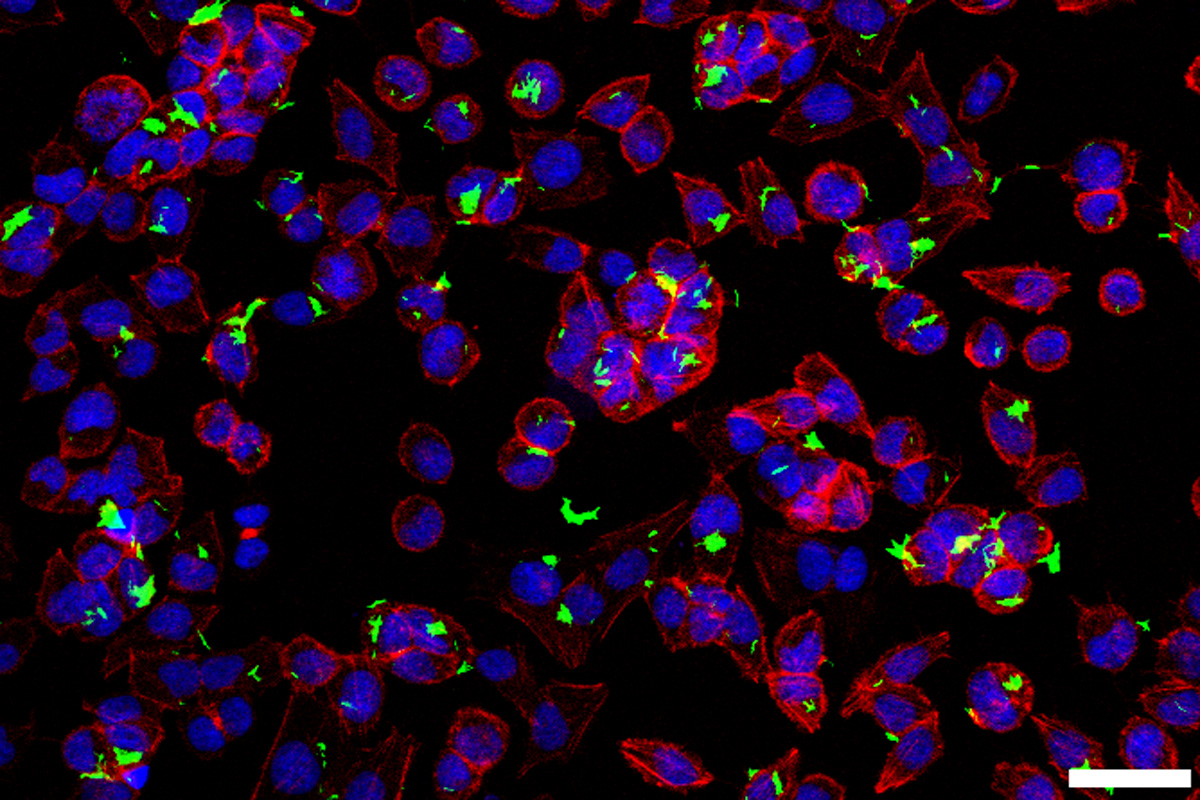
Bacille Calmette-Guérin (BCG), an attenuated strain of Mycobacterium bovis, is widely administered as a vaccine for tuberculosis. BCG is also used as a therapy for superficial bladder carcinoma. Despite being the first immunotherapy of cancer, the mechanism of action and determinants of response to BCG remain obscure. We have established that the uptake of BCG by bladder cancer cells is through macropinocytosis rather than phagocytosis. Additionally, we have shown that the difference in susceptibility between BCG-permissive and BCG-resistant bladder cancer cells is due to oncogenic activation of signaling pathways that activate macropinocytosis.
Recent work has examined the immunologic basis for tumor elimination by BCG. A longstanding question in the field has been: Is the anti-tumor immune response that eliminates the tumor directed against BCG, with the tumor killed as a bystander, or against tumor derived antigens? We have recently addressed this question (Antonelli et al) using the MB49 mouse model. We demonstrated that BCG induces tumor specific T cell immunity which is largely dependent of tumor specific CD4 T cells. BCG specific T cell immunity is not sufficient for tumor control. Further, BCG augments the effector functions of tumor specific T cells, which signal through the IFN-gamma receptor on tumor cells.
Our most recent data (Daman et al) demonstrate a surpirsing new mechanism for BCG. We demonstrated that BCG acts systemically to reprogram myelopoesis in the bone marrow, thereby enhancing the antitumor effects of teh myeloid tumor microenvironment. Please see this article for additional perspective:
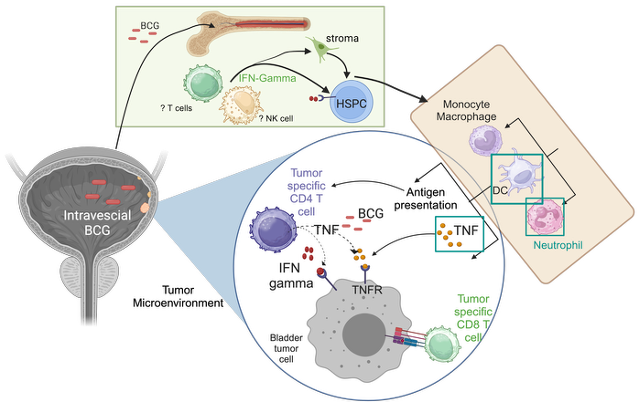
In collaboration with our clinical colleagues in urology and genitourinary oncology, we are currently expanding our studies to investigate markers of response to BCG in clinical samples and continuing our studies of the immunologic mechanisms of mycobacterial-induced tumor immunity.
More broadly, we believe that there are instructive parallels between the biology of chronic infectious lesions and tumors, both in terms of the immunologic features and in the therapeutic challenges that prevent elimination of microbes and tumor cells (see Glickman and Sawyers below).
- Huang G, Redelman-Sidi G, Rosen N, Glickman MS, Jiang X. Inhibition of mycobacterial infection by the tumor suppressor PTEN. J Biol Chem. 2012 Jun 29;287(27):23196-202.
- Glickman MS, Sawyers CL. Converting cancer therapies into cures: lessons from infectious diseases. Cell. 2012 Mar 16;148(6):1089-98. doi: 10.1016/j.cell.2012.02.015. PMID: 22424221; PMCID: PMC3465702.
- Redelman-Sidi G, Iyer G, Solit DB, Glickman MS. Oncogenic activation of Pak1-dependent pathway of macropinocytosis determines BCG entry into bladder cancer cells. Cancer Res. 2013 Feb 1;73(3):1156-67. doi:10.1158/0008-5472.CAN-12-1882. PubMed PMID: 23378476; PubMed Central PMCID:PMC3756537.
- Redelman-Sidi G, Glickman MS, Bochner BH. The mechanism of action of BCG therapy for bladder cancer—a current perspective. Nat Rev Urol. 2014 Mar;11(3):153-62. doi: 10.1038/nrurol.2014.15. Epub 2014 Feb 4. Review. PubMed PMID: 24492433.
- Redelman-Sidi G, Binyamin A, Gaeta I, Palm W, Thompson CB, Romesser PB, Lowe SW, Bagul M, Doench JG, Root DE, Glickman MS.. The Canonical Wnt Pathway Drives Macropinocytosis in Cancer. Cancer Res. 2018 Jun 5. pii: canres.3199.2017. doi: 10.1158/0008-5472.CAN-17-3199. [Epub ahead of print]
- Antonelli AC, Binyamin A, Hohl TM, Glickman MS, Redelman-Sidi G. Bacterial immunotherapy for cancer induces CD4-dependent tumor-specific immunity through tumor-intrinsic interferon-γ signaling. Proc Natl Acad Sci U S A. 2020 Aug 4;117(31):18627-18637. doi: 10.1073/pnas.2004421117. Epub 2020 Jul 17. PMID: 32680964; PMCID: PMC7414065.
- Daman AW, Antonelli AC, Redelman-Sidi G, Paddock L, Khayat S, Ketavarapu M, Cheong JG, Jurado LF, Benjamin A, Jiang S, Ahimovic D, Lawless VR, Bale MJ, Loutochin O, McPherson VA, Divangahi M, Niec RE, Pe’er D, Pietzak E, Josefowicz SZ, Glickman MS. Microbial cancer immunotherapy reprograms hematopoiesis to enhance myeloid-driven anti-tumor immunity. Cancer Cell. 2025 Aug 11;43(8):1442-1459.e10. doi: 10.1016/j.ccell.2025.05.002. Epub 2025 May 29. PMID: 40446799; PMCID: PMC12377364.