How do cells turn mechanical stress into molecular signals? And how do those signals shape responses in living tissues?
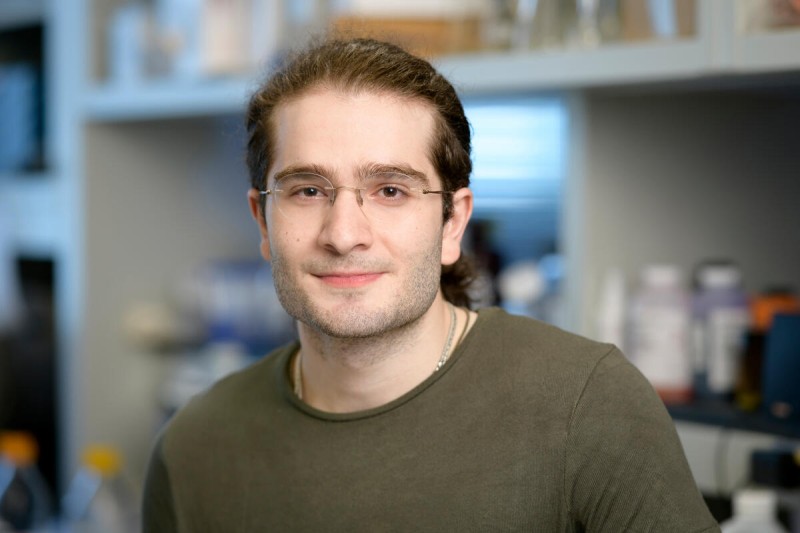
Zaza Gelashvili, a graduate student in the lab of cell biologist Philipp Niethammer, PhD, at the Gerstner Sloan Kettering Graduate School of Biomedical Sciences (GSK), has dedicated his doctoral research to investigating these questions. His work has uncovered new ways that cells sense physical change and turn that information into coordinated responses.
For these discoveries, Gelashvili has received the 2026 Chairman’s Prize, an annual award established by Louis V. Gerstner Jr., GSK Board of Trustees Chair Emeritus and namesake of the school, to recognize an outstanding GSK student who is the first author of research published in a scientific journal. The prize includes a $2,000 award.
“I am honored by this recognition and grateful for the mentorship and support I have received at MSK,” says Gelashvili, who wrote up research published in two scientific publications — Nature Cell Biology and Nature Communications. “This award encourages me to continue pursuing fundamental questions in basic research, where some of the most revealing results emerge when biological systems do not behave as predicted.”
The nucleus as a sensory surface
The nucleus of a cell is best known as the home of its genetic material. Less well known is that the membrane surrounding it, the nuclear envelope, can also register physical forces that act upon the cell.
When the nuclear envelope stretches, its membrane lipids rearrange and recruit an enzyme that helps initiate inflammatory lipid signaling, called cytosolic phospholipase A2 (cPLA2). To capture what happens when the nucleus comes under physical stress, Gelashvili and co-first author Zhouyang Shen, PhD, developed ALPIN, a genetically encoded biosensor that let them track changes in nuclear membrane tension in living cells.
Using ALPIN, the researchers found that the endoplasmic reticulum (ER), an extensive membrane network connected to the nuclear envelope, acts as a reserve of spare membrane that helps cushion the nucleus as it expands. When that reserve stays intact, nuclear tension and cPLA2 recruitment fade. But when severe stress fragments the ER, nuclear membrane tension lingers.
The same pattern held up in living zebrafish. Cells bordering a laser wound showed a disrupted ER and sustained cPLA2 recruitment, while cells farther from the wound kept a more intact ER network and mounted a shorter, reversible response. These findings were published in Nature Cell Biology, with Gelashvili as co-first author.
A wound felt from afar
In another investigation, Gelashvili and his colleagues asked how an injury’s signal travels through living tissue, beyond the cells that are actually damaged. Using transparent zebrafish larvae, they were able to watch what happens immediately after a wound forms.
When a zebrafish’s skin is broken, water rushes into the tissue, causing nearby cells and their nuclei to swell. That water-driven disturbance gave the researchers a way to ask how an intact blood vessel, sitting far from the injury, could detect that anything had happened at all.
The answer turned out to be macrophages, innate immune cells stationed near blood vessels. Even though the macrophages themselves hadn’t been injured, they picked up on the disturbance as it reached them, and cPLA2 briefly appeared at their inner nuclear membranes. The response spread outward through the tissue like a ripple, with its onset advancing at roughly 50 micrometers per second — a real-time view of wound information reaching cells well beyond where the damage occurred.
When the researchers removed the macrophages, the wound-induced rise in blood-vessel permeability was cut by roughly half, showing that macrophages play a substantial role in relaying the injury signal to nearby vessels.
This study was published in Nature Communications, with Gelashvili as first author.
“I was drawn to the interval in which injury is still almost invisible to us, but already legible to the tissue,” Gelashvili says. “I was also fascinated by how sensitively cells can read physical change, within themselves and across living tissue.”
Together, the two studies reveal complementary roles for nuclear mechanotransduction, the process by which cells sense mechanical forces and convert them into biochemical signals. The ER helps the nucleus absorb and recover from physical stress, while macrophages use nuclear force sensing to help relay information about a distant wound to nearby blood vessels. The findings may also inform research into inflammatory disease and cancer, conditions where cells routinely encounter mechanical stress.
From Georgia to GSK
Originally from Tbilisi, Georgia, Gelashvili moved to the United States to earn his bachelor’s and master’s degrees in biochemistry and molecular biology from Clark University in Worcester, Massachusetts. He graduated summa cum laude and received the highest departmental honors in biochemistry and molecular biology.
Now in his seventh year at GSK, Gelashvili is putting the finishing touches on his dissertation. Outside of the lab, you can find him baking bread, pickling vegetables, swimming, bouldering, and playing computer games.