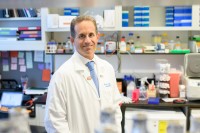
Memorial Sloan Kettering Cancer Center (MSK) announced today that Ross Levine, MD, has been named MSK’s new Chief Scientific Officer (CSO).
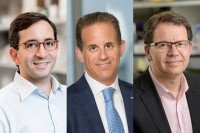
In the Lab
MSK researchers shared their latest research developments at the 2021 meeting of the American Association for Cancer Research.

In the Lab
New research looks at how a series of mutations in normal blood cells can lead to them becoming cancerous and how these mutations accumulate as cancer progresses.
Finding
New research focuses on clonal hematopoiesis, an age-related blood condition that increases the risk of blood cancer.

Feature
The word “epigenetic” literally means “above the genes.” Calico cats demonstrate a type of epigenetic inheritance called X-inactivation.

Finding
MSK investigators find that the presence of certain gene mutations in patients’ blood may mean they are more likely to get a secondary leukemia.
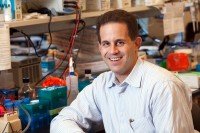
In the Lab
Memorial Sloan Kettering researchers have found why certain drugs are not sufficiently effective in treating leukemias called myeloproliferative neoplasms.

A study led by researchers at Memorial Sloan Kettering and New York University has shown that TET2 loss enhances the function of blood stem cells, causing them to renew themselves more efficiently than normal blood stem cells.

Memorial Sloan Kettering researchers helped to identify a key insight into what first goes wrong in the development of many leukemias.
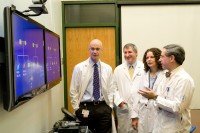
At Memorial Sloan Kettering, as the genetics revolution continues to flourish, discoveries made in the laboratory are increasingly producing real-world benefits for cancer patients.
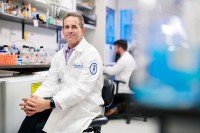
Physician-scientist Ross Levine analyzes the genetic makeup of cancer cells to identify disease pathways.