Major Research Areas
Molecular Biology
Office Phone:212-639-5890
Office Fax:212-717-3627
E-mail:kmarians@sloankettering.edu
Lab Phone:212-639-5891 / 5892
Lab Fax:212-717-3627

Kenneth J. Marians
Ken

Research in my laboratory centers on (i) the mechanisms of replication fork reactivation and (ii) the coordination of replication, chromosome decatenation and segregation, and cytokinesis. Our studies on replication restart use purified recombination and replication proteins in various well-defined systems reconstituted in vitro that model replication fork stalling, collapse, and reactivation. Our studies on chromosome segregation utilize a combination of biochemical, cell biological, and molecular genetic approaches.

Mechanisms of Replication Fork Reactivation

It was appreciated by several groups in the early 1990s that an encounter between a progressing replisome and template damage was likely to act as a block to the replication fork, thus creating a demand for repair of the damage and reactivation of replication in order to preserve genomic integrity. Our discovery, in 1991 that E. coli strains deficient in the activity of PriA were constitutively induced for the SOS response despite the fact that PriA had no known role in chromosomal DNA replication, was instrumental in the development of our own proposal on the need for replication restart because we knew from previous biochemical studies that PriA directed assembly of a primosome (the multi-protein complex responsible for unwinding the parental template strands and priming of Okazaki fragment synthesis during replication) on DNA.

Additional key insights were developed by Kogoma, who discovered that the priA null strains were defective in recombination and double-strand break repair (DSBR) and proposed that PriA was responsible for mediating replisome assembly at recombination intermediates, resulting in recombination-directed replication (RDR).

The current picture of what happens when a replication fork encounters DNA damage is given in Figure 1. In (i) the replication fork is approaching some form of damage (X) in the leading-strand template. If the damage is a nick in the template strand, the replication fork will collapse, generating a double-strand break (DSB) (ii) The only possible pathway of replication reactivation at this point is the generation of a recombinant joint molecule between the broken sister arm and the intact arm of the chromosome via the action of RecA and RecBCD. This recombination intermediate [a D loop (iii)] is then used as a substrate for replication restart (iv).


Figure 1
Figure 1 Pathways of replication fork repair

If the damage is a chemical base adduct, replication is arrested and, in many instances, it appears that the nascent strands will anneal to each other in a reaction termed nascent strand regression [NSR (v)]. This event regenerates the template to allow repair of the damage by either the nucleotide excision or base excision repair pathways. Replication restart can then be effected in either 1 of 2 ways: the Holliday junction (HJ) formed by NSR can be cleaved by one of the HJ resolvases (either RuvC or RusA), generating a situation identical to that for fork collapse, or the NSR can be reversed and the forked structure itself serves as the substrate for restart (vi).

Replication restart is an essential housekeeping function in bacteria. Clearly, when only 2 replisomes are responsible for duplicating the genome, reactivating any arrested or collapsed fork is crucial to survival. Estimates vary but it is likely that any particular replisome loaded at the chromosomal origin of replication has a 15 to 50 percent chance of being inactivated per generation. In higher eukaryotes, genomic instability manifests when defects in homologous recombination (HR) prevent the repair of DSBs that arise at arrested replication forks. These repair pathways involve many proteins whose deficiency result in cancer predisposition.

Projects

  • Double-strand Break Repair by Recombination-directed Replication
  • Processing of Regressed Replication Forks
  • Multiple Pathways of Replication Restart

Chromosome Dynamics and Cytokinesis

In B. subtilis and E. coli, the division plane at mid-cell is a crucial locus where most of the events leading to cytokinesis take place. The DNA polymerases assemble and replicate DNA at mid-cell. This replication factory remains stationary, implying that the DNA is drawn through the factory during replication (Figure 2).


Factory Model of Bacterial Replication
Figure 2 The Factory Model of Bacterial Replication
(i) Replication at the factory (paired black triangles) on the red chromosome generates 2 blue daughter chromosomes that are spooled out to opposite halves of the cell. (ii) Initiation on the blue daughters at oriC (black dots) generates 2 sets of green daughter chromosomes that are spooled out to opposite sides of the parental blue ones. (iii) Replication on the red chromosome has completed and cytokinesis is ongoing, leaving 2 active factories in the cell, 1 on each of the blue chromosomes -- no thumbnail, reasonable size.

Consistent with the outlines of the factory model, during the replication cycle, regions of the chromosome undergo specific movements dictated by their distance from the origin of replication. The origin and terminus regions are located at mid-cell at the beginning of a round of replication. After duplication, the origins are relocated to the quarters of the cell, defining the site of the next initiation of replication. On the other hand, the terminus region remains centrally located even after it is duplicated, with the sister ter regions moving to either side of the invaginating septum just at the end of the cell cycle. Tracking the position of the factory and various sequence elements of the chromosome becomes more complicated in E. coli growing rapidly on rich media. Under these conditions, re-initiation of replication can occur twice before completion of the initial round of replication, generating a scenario where bacterial cells can contain as many as 7 factories. The program for chromosome segregation and cell division, however, is triggered anew for each round of initiation. Thus, in rapidly growing cells, partition separates replicating chromosomes.

Recent evidence suggests that as the newly replicated DNA is extruded from the factory, the partially replicated sister chromosomes are directed to opposite ends of the cell by interactions with SeqA, a protein that binds hemimethylated DNA, and MukB, a SMC-like protein found in bacteria that does not have bona fide SMC family members. However, the mechanism of chromosome segregation in bacteria is still unclear even 40 years after the first plausible scenario was presented in the replicon hypothesis. Some of the force for separation of the sister chromosomes may derive from DNA replication itself. Movement of the DNA through the factory has been proposed to pump the sister chromosomes to the opposite halves of the cell (the extrusion-capture model).

The major structure for cytokinesis is the septal ring. Formation starts very early after the initiation of replication at mid-cell with the assembly of the FtsZ ring. FtsZ is a tubulin-like protein and contraction of the ring results in cell division. The septal ring is linked to chromosome segregation via FtsK. FtsK is a bifunctional protein. The N-terminal domain consists of 4 transmembrane segments and is involved in closure of the septal ring. The C-terminal part of FtsK is cytoplasmic and contains an AAA domain that is necessary for normal chromosome segregation.

Our interests in the mechanisms of chromosome segregation arose from our studies during the early 90s on the roles during DNA replication of the four E. coli DNA topoisomerases. Because Topo IV, the topoisomerase that decatenates the replicated sister chromosomes, could be considered the most distal actor in DNA replication and the most proximal actor in chromosome segregation and partition, we searched for connections between these macromolecular processes that were mediated by Topo IV. Screens for high-copy suppressors of the temperature-sensitive and partition defects of either the parE10 or parC1215 alleles, encoding the subunits of Topo IV, proved particularly fruitful. The parE screen yielded dnaX, encoding the and subunits of the DNA polymerase III holoenzyme, the cellular replicase; whereas the parC screen yielded parC, topB, encoding Topo III, dnaN, encoding the subunit of the DNA polymerase III holoenzyme, and setB, encoding an integral membrane protein.

Our efforts to understand the bases for suppression by these genes have revealed that Topo IV activity is temporally regulated in the cell in a manner that involves the replication factory and probably FtsK, that Topo IV associates with FtsK in the cell; and this association stimulates the activity of Topo IV; and that SetB appears to participate in a pathway that could provide a motive force for chromosome segregation and is likely to involve the bacterial actin homolog MreB.

Projects

  • Temporal and Spatial Regulation of Topoisomerase IV Activity
  • FtsK and Topo IV — Does the Cell Contain a Decatenosome?
  • MreB and SetB — Do Bacterial Cells Contain a Mitotic Apparatus?

Photo
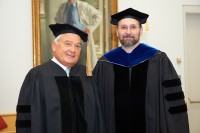
Ken and Institute Director Tom Kelly confer.


PrintEmail This Page